
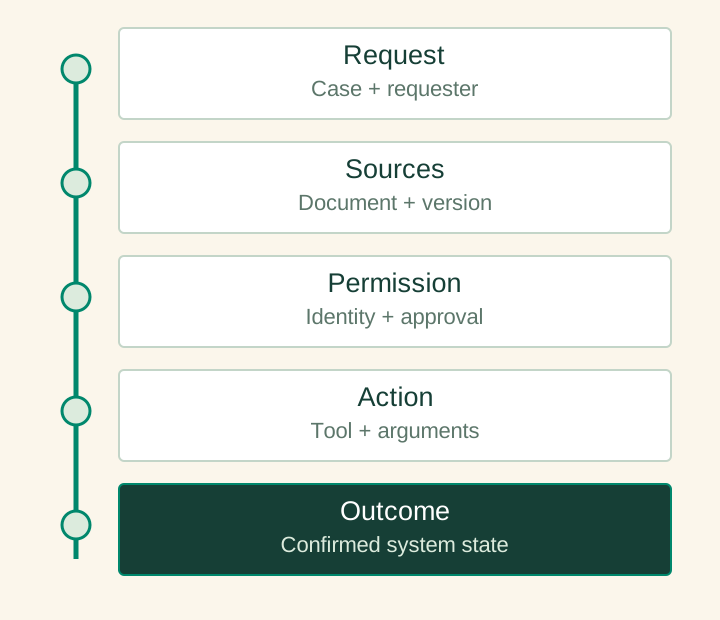
When an AI system can take actions, a conversation transcript is only part of the record. Operations teams need to establish what was requested, what the application authorized and what actually changed. Those facts may live in different systems unless they are connected by design.
Start with a reconstructable event
Assign an identifier to the workflow and carry it across retrieval, model calls and connected systems. Record timestamps, configuration versions and the final business outcome. Avoid assuming that a successful tool response proves the requested change occurred; capture confirmation from the system of record when that matters.
Keep the source and authority visible
Retain references to the information used, the user or service identity and the permission decision. For approved actions, record what the reviewer saw and what they authorized. A later reviewer should be able to distinguish an AI proposal from an action the system executed. Blocked actions and failures are also useful evidence.
Control the evidence store
Logs can become another copy of sensitive business data. Decide what must be retained, where it is stored and who may inspect it. Use references or redaction where full content is unnecessary. Retention, access and export should follow the organization’s requirements. An audit trail that exposes restricted information creates a new problem.
Distinguish intent, attempt and outcome
A request to update a record, a tool call attempting the update and a confirmed update are three separate events. Preserve that distinction in the schema. Include a correlation identifier, relevant record identifier and an outcome state that is meaningful to the business process. A timeout may leave the outcome unknown rather than failed.
The recovery procedure must handle that uncertainty. Before retrying a consequential action, check whether the first attempt completed or use a mechanism that prevents duplicates. Record the recovery decision. This is why an operational audit trail needs information from the connected system, not only the model’s statement that it completed the task.
Test a reconstruction request
Choose a completed and a failed case. Ask an independent reviewer to explain the request, sources, authority, action and result from the retained records. Note the missing links. Repeat after changes to tools or logging. This practical exercise is more informative than counting the number of log fields collected.
Before the next decision
Planning checklist
- Shared workflow identifier across components
- Input, source, approval and outcome references
- Evidence retention and access policy
- Successful reconstruction of failed and completed cases
Sources and further reading
Sources checked 5 October 2026. The design recommendations in this guide are AID’s analysis. Sector obligations depend on the use case and jurisdiction.
Apply this to a defined workflow
AID’s Model Governance & Audit Pack can organize implementation evidence and identify gaps in the operating record.