
A legal research assistant should make verification easier. If attorneys must reconstruct the source of every assertion, faster drafting may simply move effort downstream. The workflow needs a clear distinction between locating authority, drafting from it and deciding whether it can be relied on.
Require an inspectable source
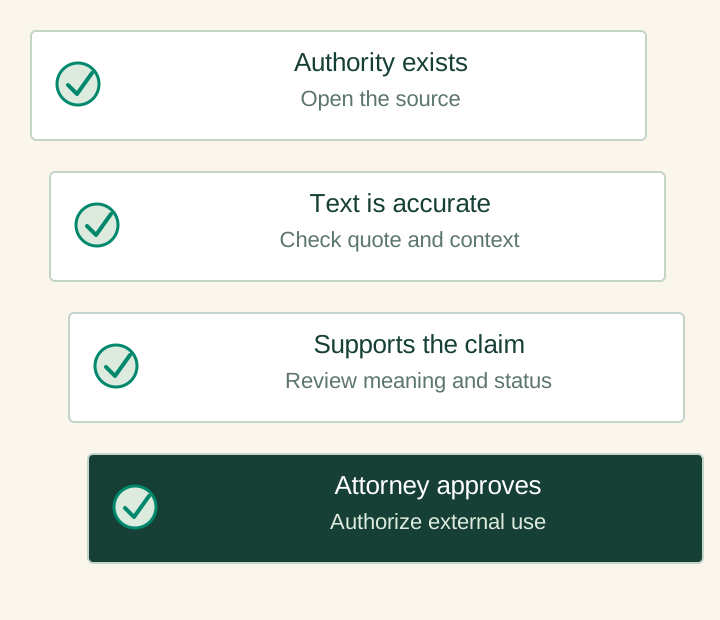
For each legal proposition, retain the authority and a link or reference that opens it in an approved source. Confirm that the document exists and is the intended case, statute or rule. A plausible citation format is not enough. If a source cannot be opened, mark the proposition as unverified rather than allowing it to blend into a polished draft.
Verify what the authority says
A real case can still be used incorrectly. Review the quoted text, its surrounding context and whether it supports the proposition. Check jurisdiction, procedural posture and subsequent treatment using the firm’s legal research process. Retrieval reduces some errors but does not establish that an authority remains good law or is applicable to the matter.
Design review into the work product
Separate sourced statements, draft argument and unresolved questions. Give the attorney a review view that makes unsupported material conspicuous. ABA Formal Opinion 512 addresses competence and other professional duties in generative-AI use; responsibility for the work remains with the lawyer. An approval checkbox should represent actual review of the underlying material. ABA Formal Opinion 512.
Use a claim-level review record
For a material statement, record the proposition, cited authority, supporting passage and review status. If the source supports a narrower proposition, change the draft rather than stretching the authority. If the source is unavailable, retain the uncertainty. This format gives the reviewer a manageable unit of work and makes unresolved items visible before a document is released.
Treat quotations and summaries differently. A quotation requires exact comparison with the source; a summary requires checking meaning and omitted qualifications. Both need context. The system can help organize these checks, but it should not label a proposition legally valid based solely on a model’s self-assessment or a successful retrieval.
Use failures to improve the system
Record categories of correction, such as nonexistent authority, inaccurate quotation or unsupported inference. Add representative failures to the acceptance set. Recheck the workflow after changes to models, prompts or source access. The objective is a repeatable verification process, with clear limits on what the assistant may release without review.
Before the next decision
Planning checklist
- Source exists and can be inspected
- Quotation and proposition verified
- Jurisdiction and legal status checked
- Attorney approval before external use
Sources and further reading
Sources checked 5 October 2026. The design recommendations in this guide are AID’s analysis. Sector obligations depend on the use case and jurisdiction.
Apply this to a defined workflow
AID can build source-linked drafting and review workflows that support the firm’s verification process.