
An AI-generated change may compile, run and pass the tests supplied with it while still changing an important business rule. The review needs an independent definition of correct behavior. This is particularly important when modernizing software whose requirements live in code and operational habits.
Recover the business rules first
Map the paths that calculate, authorize, route or persist important information. Ask a subject-matter expert to review ambiguities rather than allowing the implementation tool to invent a rule. Keep references to the source code or existing behavior that supports each requirement. A modernization backlog should distinguish required parity from intentional changes.
Use independent acceptance evidence
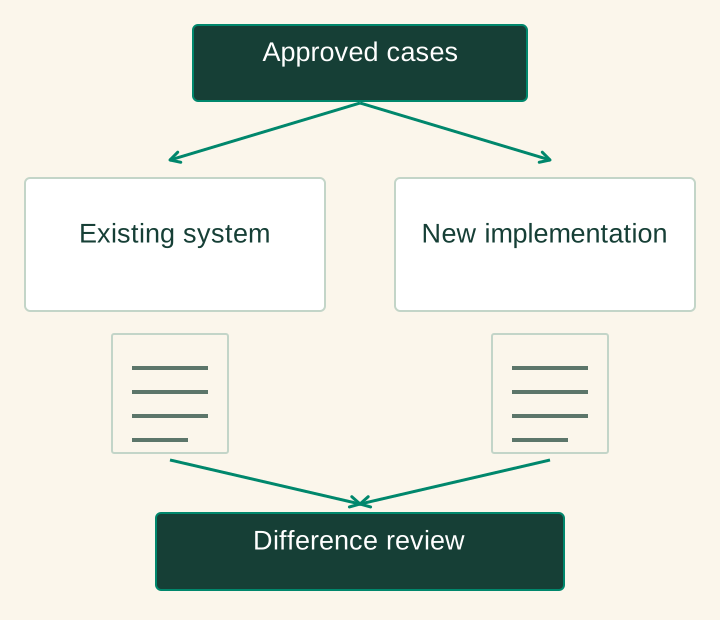
Tests written from the same assumptions as the new code can repeat its mistake. Build characterization cases from the existing system, operational records and approved requirements. Include exceptions, boundaries and invalid inputs. Where the old system is wrong, record the desired correction explicitly so that a difference is not mistaken for a regression.
Review what the code can affect
Inspect data access, authorization, error handling and external calls as well as the happy path. A change that produces the right screen can still write the wrong record or expose information. Check the actual resulting state, including audit records and retry behavior. Human review remains important for architectural decisions and assumptions that tests do not capture.
Make parity visible to the business owner
A financial calculation provides a useful test of the method. Capture representative inputs and outputs from the existing application, including rounding, effective dates and exception handling. Run the migrated implementation against those same inputs. Present differences in business terms: which value changed, which rule appears responsible and whether the change was approved.
Do not resolve every difference by making the new application resemble the old one. Some differences expose existing defects or a requirement that has changed. A subject-matter reviewer should approve those differences and create an updated reference case. This leaves a record of intent instead of a test suite that quietly encodes whichever behavior happened to ship first.
Release in observable slices
Move a bounded capability with a rollback plan and compare the old and new behavior before widening scope. Keep a record of accepted differences. The release report should explain what was tested, what remains untested and how production issues will be detected. This gives the business owner a usable basis for approving the change.
Before the next decision
Planning checklist
- Business rules linked to existing behavior
- Independent cases for critical paths and exceptions
- Security and side-effect review
- Accepted differences and rollback evidence
Sources and further reading
Sources checked 5 October 2026. The design recommendations in this guide are AID’s analysis. Sector obligations depend on the use case and jurisdiction.
Apply this to a defined workflow
AID’s modernization work can be scoped around business-rule discovery, bounded changes and evidence of preserved behavior.