
Prior authorization contains several kinds of work: assembling records, locating policy criteria, identifying missing information and making a coverage determination. Treating them as one automation task hides the points where clinical expertise and accountable review are essential.
Map the work before selecting automation
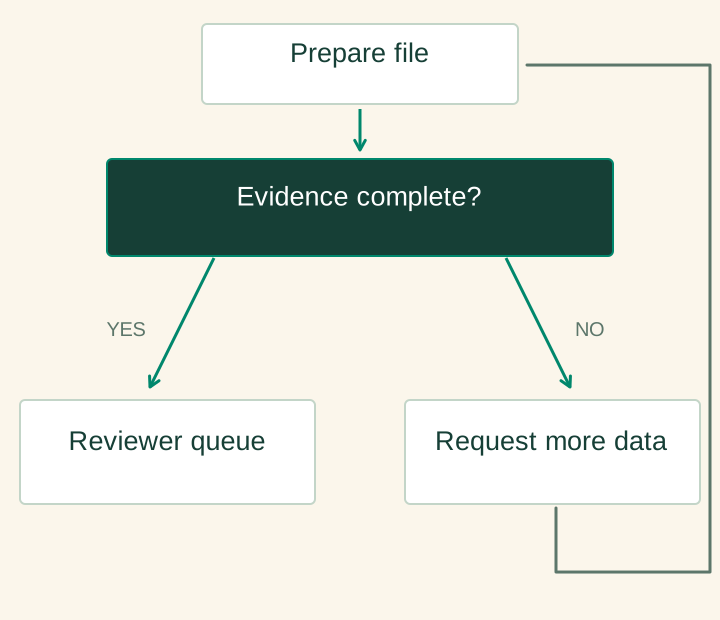
Follow a request from receipt to disposition. Identify repeated preparation tasks, data gaps and review queues. Mark the steps where a person makes a clinical or coverage judgment. This process map should determine the first scope. A preparation assistant can be evaluated on completeness and source accuracy without granting it authority to decide a case.
Distinguish policy design from headlines
CMS describes the WISeR model as using technology alongside human review, with recommendations for non-payment determined by appropriately licensed clinicians. That specific model should not be generalized into a claim that all prior-authorization decisions can or should be automated. For a local implementation, clinical, legal and operational owners need to define the permitted role. CMS model description.
Give reviewers an evidence package
Present the requested service, relevant record excerpts, applicable policy version and unresolved questions together. A reviewer should be able to inspect a cited passage without searching the entire chart. Do not convert an absent document into a negative clinical conclusion. Missing evidence should remain a visible exception with a defined follow-up route.
Treat reviewer workload as a design constraint
A review gate is meaningful only if the reviewer has enough information and time to use it. Present discrepancies prominently and avoid filling the screen with a long generated narrative. The package should show what is complete, what is missing and where each material statement came from. A reviewer who accepts a package should be accepting an inspectable body of evidence.
Test a request with a missing page and one with contradictory dates. Observe whether the interface encourages verification or makes the uncertainty easy to overlook. Record the correction and the extra work it caused. These cases reveal whether automation reduces preparation effort while preserving the quality of the existing review.
Measure whether review actually improves
Test both straightforward and incomplete submissions. Track extraction corrections, missing-document detection and reviewer effort separately. Include queue delays and failed handoffs in operational testing. A system that prepares accurate summaries but sends them to the wrong team has not completed the workflow. Retain the final human decision and its relationship to the draft.
Before the next decision
Planning checklist
- Preparation and decision steps separately assigned
- Policy-version and source-document links
- Visible missing-information queue
- Reviewer acceptance and escalation measures
Sources and further reading
Sources checked 5 October 2026. The design recommendations in this guide are AID’s analysis. Sector obligations depend on the use case and jurisdiction.
Apply this to a defined workflow
AID can scope a prior-authorization support workflow around document preparation, evidence retrieval and clinician review.