
The most useful first implementation in prior authorization may be the preparation work before a reviewer makes a decision. The scope can be defined around receiving documents, identifying missing information and assembling a source-linked summary for the existing review process.
Receive and classify the submission
Identify the request and match incoming records to it using validated identifiers. Preserve the original documents and record any processing failure. Check required fields with deterministic rules where possible. Ambiguous identity matches, unreadable pages and missing records should enter a review queue rather than being silently completed by the model.
Retrieve the relevant policy
Use an approved policy collection with effective dates and ownership. Retain the selected version and the passages used. If multiple policies may apply, expose the ambiguity. The output should distinguish facts found in the record from criteria in a policy and from information that remains unavailable.
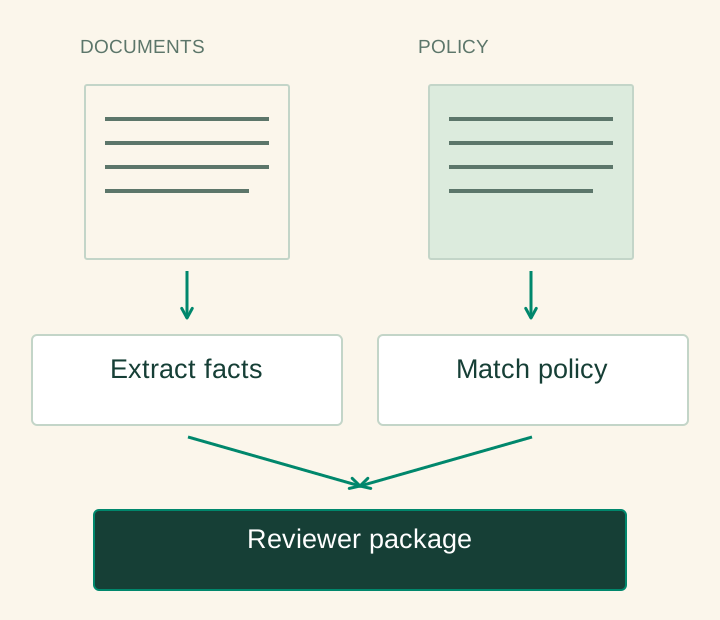
Assemble a package a reviewer can use
Present the requested service, extracted facts, source references and unresolved items in the reviewer’s familiar format. Keep the original record one step away. The system’s task is to reduce preparation work while preserving the reviewer’s ability to inspect the evidence. Approval and denial authority should be defined separately from this preparation scope.
Use a structured exception queue
Define a small set of operational exceptions: unmatched request, unreadable document, conflicting identifier, missing evidence and unresolved policy applicability. Give each a destination and the information needed to resolve it. Avoid a single generic failure state that forces the next person to diagnose the entire pipeline.
The exception record should preserve the original input and the stage at which processing stopped. After correction, resume from a controlled point and verify that the package contains the corrected information. Test duplicate submissions and revised documents so a newer file does not silently coexist with an outdated package. This makes document preparation a manageable process rather than a sequence of model calls.
Carry the record through the handoff
Link the package to its inputs, processing configuration and review disposition. Protect patient information across storage, retrieval and logging; HHS cloud guidance makes clear that contractual arrangements and risk analysis are part of the design. Test whether the receiving system accepts the package and whether a failed transfer can be retried without duplicating work.
Before the next decision
Planning checklist
- Validated request and patient matching
- Approved policy collection and effective dates
- Missing-information and ambiguity queues
- Source-linked reviewer package and handoff record
Sources and further reading
Sources checked 5 October 2026. The design recommendations in this guide are AID’s analysis. Sector obligations depend on the use case and jurisdiction.
Apply this to a defined workflow
AID can build and evaluate the preparation workflow before any expansion into more consequential actions.