
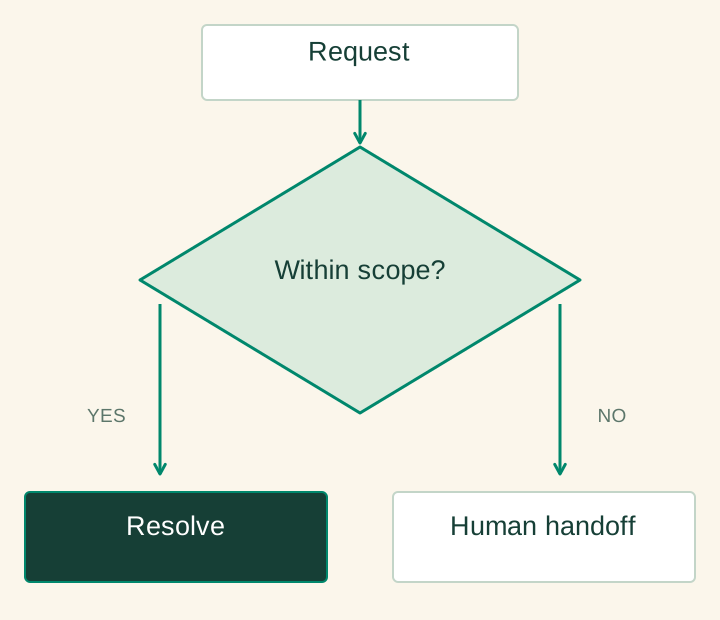
A useful service agent resolves a defined request and transfers the rest cleanly. Its value depends on the quality of both paths. An agent that answers beyond its authority can create more work than it removes, while an agent that transfers every request offers little operational benefit.
Choose a request with a clear boundary
Begin with an identifiable call or message type, such as explaining an approved policy or collecting information for a service ticket. Document the information needed, the permitted response and the situations requiring a person. Keep urgent, disputed or sensitive requests on a clearly defined escalation path.
Separate information from authority
Retrieving a policy is different from changing an account. Specify each connected tool’s scope, required identity checks and approval conditions. Validate inputs outside the language model and make repeat requests safe. A prompt telling the agent to be careful is not a substitute for enforcing permissions in the application.
Make the handoff useful
Send the receiving team a concise record of the request, verified facts, missing information and actions already attempted. Avoid making a customer repeat the entire interaction. Provide a route when the normal handoff destination is unavailable, and ensure the agent does not claim a transfer or action succeeded before it has confirmation.
Write the escalation contract
The handoff contract should specify a destination, required context and confirmation that a person or queue received the request. A billing question with missing information may belong in a routine queue; an urgent safety concern needs a different route. Those distinctions should be encoded in the application and tested with the responsible service team.
Review what happens when a caller changes the request after the agent has prepared an action. The system should not execute an earlier proposal merely because it was once valid. Capture the current request, revalidate authority and confirm any consequential action according to the organization’s policy. This is a workflow control, not simply a conversational tone requirement.
Test conversations and outcomes
Use scenarios with ambiguity, interrupted requests and changing instructions. Assess whether the final service outcome is correct and whether the agent escalated at the right point. Review failed and transferred interactions alongside successful ones. Track reviewer correction effort and unresolved requests, rather than relying only on the number of conversations handled.
Before the next decision
Planning checklist
- Allowed topics and tool actions
- Identity checks and approval conditions
- Handoff record and unavailable-team fallback
- Tests of successful, refused and escalated requests
Sources and further reading
Sources checked 5 October 2026. The design recommendations in this guide are AID’s analysis. Sector obligations depend on the use case and jurisdiction.
Apply this to a defined workflow
AID can implement a bounded service workflow with controlled tool access, explicit escalation and outcome-based evaluation.